by Traverse Legal, reviewed by Enrico Schaefer - October 19, 2026 - Account Deactivation or Termination, Airbnb, Short Term Rentals
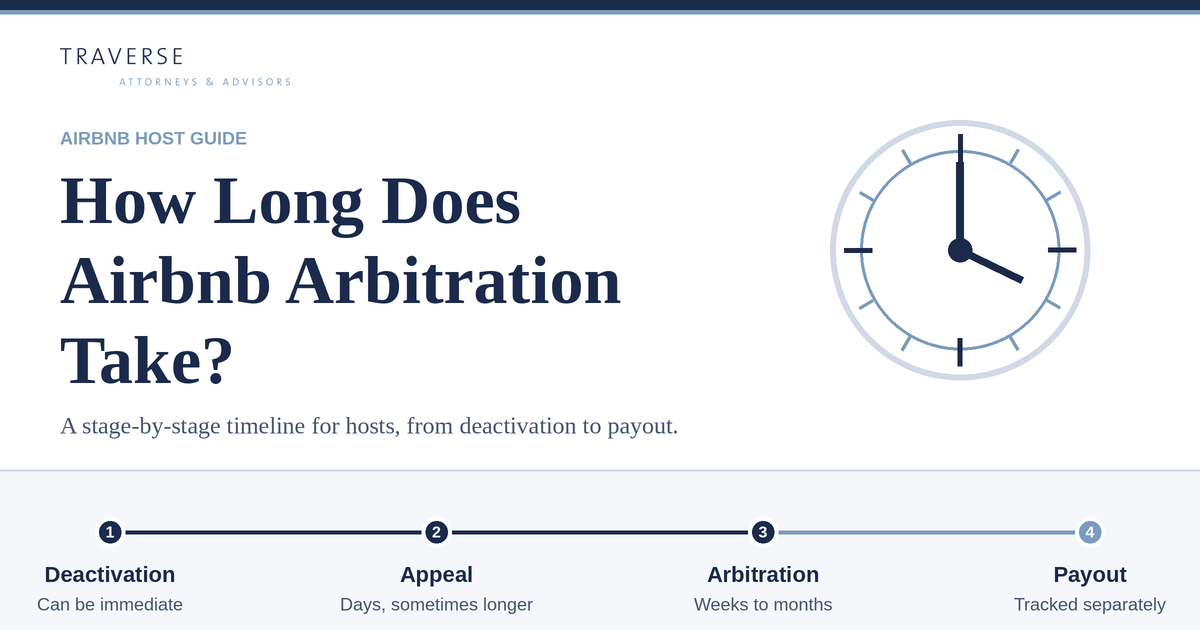
The answer to how long Airbnb arbitration takes depends on where the dispute is in the process and how complete the records are. A simple support issue may move quickly. A deactivation, appeal, or arbitration dispute usually takes longer, especially if Airbnb asks for more information or if the account records are incomplete.
This article breaks the process into stages so you can compare:

Payout timing can be separate from everything else. A host may wait for money even after the underlying dispute is already in motion.
Airbnb can restrict, review, or deactivate an account quickly.
In some cases, the listing disappears, or the account is limited almost right away. In other cases, Airbnb leaves the account in a review state while it asks for more information or waits for a response.
The timing depends on what triggered the action and how much Airbnb already has in the record.
A simple policy or security issue may move fast. A guest complaint, payout problem, or account review may take longer because Airbnb may ask for documents, clarification, or a response before taking the next step.
What matters most is not just how fast Airbnb acts, but whether the host preserves the notice, screenshots the account, and tracks what changed. That record becomes important if the issue later turns into an appeal or arbitration.
The first appeal window can move quickly, but the response time varies.
Some hosts hear back in a few days. Others wait longer if Airbnb asks for more information or sends the appeal through another review path. If the appeal is incomplete, inconsistent, or missing records, the process can slow down even more.
A practical appeal starts with the exact notice, a short timeline, and the documents that directly address Airbnb’s concern. If Airbnb asks follow-up questions or requests more records, the clock starts again from that point.
The appeal is less about one fixed deadline and more about whether the host can give Airbnb what it needs without delay.
Arbitration takes longer than an appeal or a support review.
Once the dispute moves into arbitration, the process becomes more formal. There may be filing steps, responses, document exchange, scheduling, and sometimes settlement discussions before anything is resolved.
That means the timing can stretch from weeks into months, and sometimes longer if the records are incomplete or the dispute is more complicated.
A straightforward dispute with clear records may move faster than a broader account, payout, or contract issue. If the case involves multiple listings, disputed payouts, or conflicting versions of the facts, the timeline usually extends.
The important thing is to treat arbitration as a slower phase of the process, not a quick fix. Hosts who expect an immediate result end up frustrated because formal dispute resolution has its own pace.
Payout timing depends on the kind of money involved.
A routine payout delay may clear once the hold lifts or the booking cycle ends. Money tied to a dispute usually takes longer.
A host may be waiting on:
When Airbnb is still reviewing the account, the payout may stay on hold until the review ends. A dispute that moves into arbitration or another formal process may not resolve until the case is decided or the parties reach agreement.
That is why payout timing should be tracked separately from appeal timing. A host may regain access before getting paid, or receive payment before the full dispute is over.
When the payout issue is unclear, save the payout history, the relevant notices, and any message showing what Airbnb says is holding the funds.
Several things can stretch the timeline.
Sometimes the process slows because the issue has moved beyond support and into legal escalation. At that point, the timeline is no longer just about waiting for Airbnb to answer. It may depend on records, claim preparation, and whether the dispute is being handled through appeal, arbitration, or another formal process.
Traverse Legal represents hosts and short-term rental operators across the full lifecycle of the business. Account deactivation arbitrations. AirCover and guest damage disputes. Chargebacks and payout holds. Property management and arbitrage contracts. Owner agreements. Corporate formation and financing. Legal structuring work coordinated with our clients’ tax accountants on cost segregation and bonus depreciation planning. If you run a short-term rental business, we have very likely handled your problem before.
Prior results do not guarantee a similar outcome. Every case turns on its specific facts. This page is attorney advertising.
The delay becomes more serious when it affects the business.
That is why timing matters. A short delay may be frustrating, but a longer one can start causing real financial harm. If the wait is already affecting bookings, payouts, or access, the host should preserve the record and track the business’s impact carefully.
Use the waiting period to build a clean record.
Save:
If Airbnb asks for more information later, you will already have the key records in one place.
Keep the files organized by date if possible. If the issue involves more than one listing, separate the records by listing so the timeline stays clear.
The goal is to show what happened, when it happened, and what Airbnb said at each step. That is especially helpful if the dispute later moves from a support issue to a formal appeal or arbitration.
It can happen quickly in some cases, but other matters stay in review for longer. The timing depends on what triggered the issue, what records Airbnb already has, and whether the host responds quickly with the information requested.
There is no fixed timeline that applies to every appeal. Some hosts hear back in days, while others wait longer if Airbnb asks for more records or sends the issue through a different review path.
Arbitration usually takes longer than an appeal because it is a more formal process. The timeline can stretch from weeks into months, depending on the claim, the records, and how the dispute progresses.
That depends on whether the money is tied to a routine payout, a hold, or a dispute. If the payment is still being reviewed, it may take longer before the funds are released.
Save your messages, keep the timeline current, and note the dates of every attempt to reach Airbnb. If the lack of response is affecting bookings, payouts, or access, the delay may become part of the dispute record.
Consider contacting an Airbnb lawyer if the delay is affecting payouts, bookings, account access, or multiple listings, or if Airbnb is not giving a clear path forward. Legal review may also make sense if the issue is already tied to deactivation, appeal denial, or arbitration.
A delay becomes more serious when it starts affecting bookings, payouts, or account access.
At that point, preserve the record and keep tracking what changed.
A short delay may be frustrating. A longer delay can create real business harm. Blocked calendars, held payouts, and multiple affected listings can point to a larger issue that needs a case-specific review.
Traverse Legal can review the account history and help you evaluate the next move. To discuss your situation, book a consultation through the contact form or call 866-936-7447.
As a founding partner of Traverse Legal, PLC, he has more than thirty years of experience as an attorney for both established companies and emerging start-ups. His extensive experience includes navigating technology law matters and complex litigation throughout the United States.

This page has been written, edited, and reviewed by a team of legal writers following our comprehensive editorial guidelines. This page was approved by attorney Enrico Schaefer, who has more than 20 years of legal experience as a practicing Business, IP, and Technology Law litigation attorney.
